Free AI NDA Generator
Describe the parties and what needs protecting, and our AI drafts a non-disclosure agreement in seconds. Mutual or one-way. Refine the clauses in the preview, then export to PDF or Word. Free, no account needed.
An NDA maker for every situation
Tell the AI who’s sharing what, and it returns a complete non-disclosure agreement. Definitions, obligations, term, and signature blocks, ready to edit and download.
From a quick description to a finished NDA in three steps
Describe the parties
Who’s disclosing, who’s receiving, what’s confidential, and how long it must stay protected.
AI drafts the NDA
You get a complete agreement. Definition of confidential information, obligations, exclusions, term, and signatures.
Edit & download
Click anywhere to edit the live preview, then download a polished PDF or Word file ready to sign.
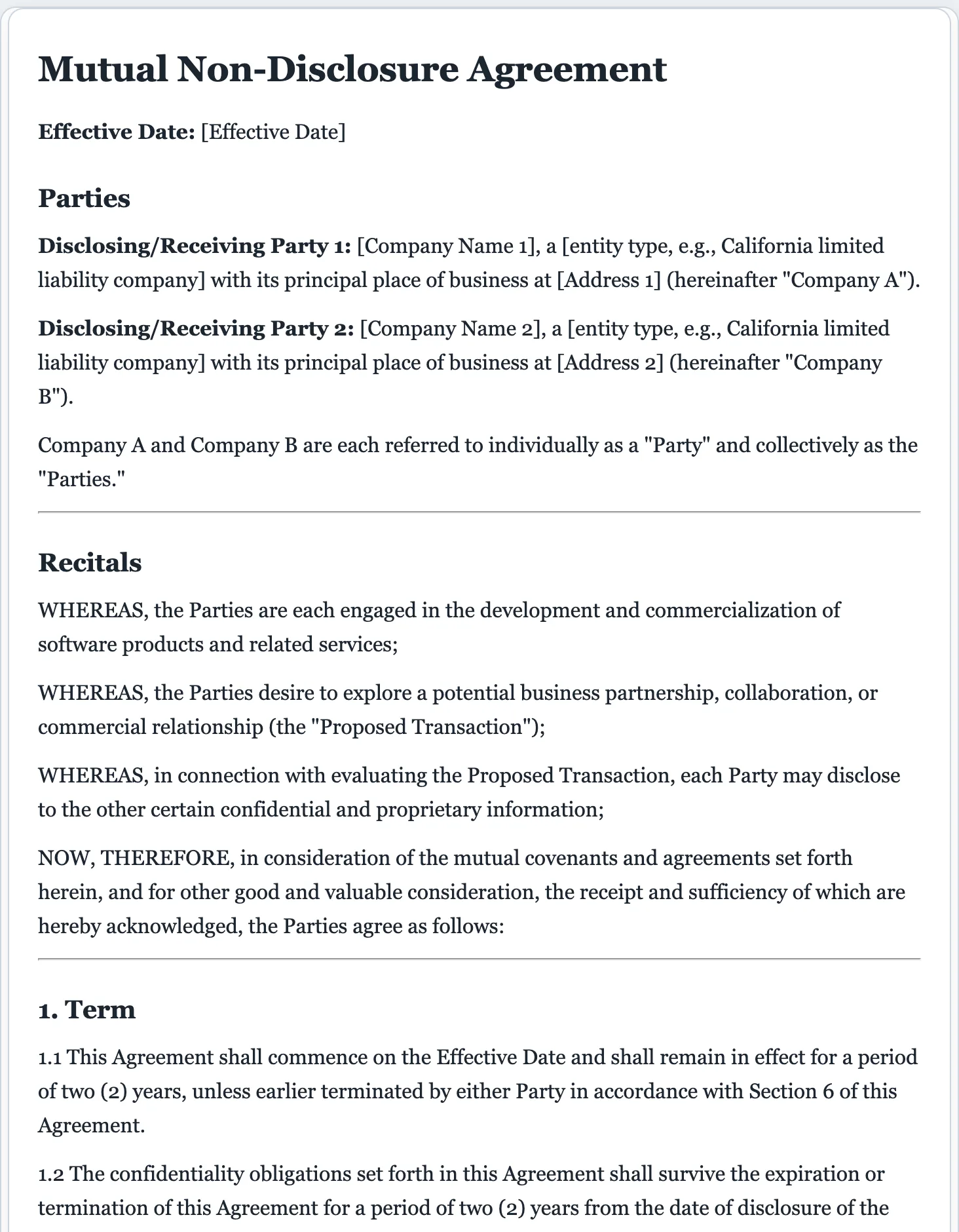
Not just AI. Built on real, lawyer-reviewed NDAs.
FormsPal’s AI NDA generator drafts from a library of professionally written non-disclosure agreements, so your NDA starts from real legal structure. Not a blank page.
- Mutual and one-way structures with the clauses each needs.
- A matching lawyer-reviewed NDA template whenever you want a vetted form.
- PDF or Word export in one click, and your text stays on your device.
What a non-disclosure agreement includes
Every NDA the AI drafts has the clauses that make confidentiality enforceable. Keep, cut, or reword any of them in the live preview.
- The disclosing and receiving parties, or both sides in a mutual NDA.
- A precise definition of what counts as confidential information.
- Exclusions for information that is public or already known.
- The receiving party's duty to protect and not disclose.
- Permitted-use terms limiting how the information may be used.
- The term, how long confidentiality must be kept.
- A return-or-destroy clause for when the relationship ends.
- Remedies, including injunctive relief, if the NDA is breached.
- A governing-law clause for your state.
- Dated signature blocks for each party.
How to write an NDA
A non-disclosure agreement is only as strong as its definitions. These are the decisions that determine whether yours actually protects your information.
Decide one-way or mutual
If only one side is sharing secrets, a one-way (unilateral) NDA is enough. If both sides will exchange confidential information, use a mutual NDA so each is protected.
Define confidential information precisely
Be specific about what's covered: business plans, customer lists, source code, pricing, designs. An overly broad definition like “everything we tell you” is harder to enforce than a clear, scoped one.
Carve out the exclusions
Standard NDAs exclude information that's already public, that the receiver already knew, or that they develop independently. These carve-outs keep the agreement reasonable and enforceable.
Set obligations and permitted use
State exactly what the receiving party must do (keep it secret, limit access) and what they may use the information for. The narrower the permitted use, the more protection you keep.
Choose a term, add remedies, and sign
Set how long the duty lasts (often one to five years, sometimes indefinitely for trade secrets), add a remedies clause, name your governing state, and have both parties sign and date it.
For high-stakes confidentiality, have a licensed attorney review the final NDA or start from a lawyer-reviewed NDA template.
NDA generator questions
Is the NDA generator free?
Yes. You can create and download non-disclosure agreements for free, with no signup. A small daily cap keeps the generator responsive for all users.
How does the AI NDA generator work?
Describe the disclosing and receiving parties, what information is confidential, and how long it must be protected. The AI drafts a complete NDA. Definitions, obligations, exclusions, term, and signature blocks, which you then edit and download.
Is an AI-generated NDA legally binding?
An NDA is generally binding once both parties with capacity sign it and agree to its terms. Our drafts are a strong starting point, not legal advice; for high-stakes confidentiality, have a licensed attorney review the final agreement.
What’s the difference between a mutual and one-way NDA?
A one-way (unilateral) NDA protects information one party discloses to another. A mutual NDA protects confidential information that both parties share. Common when two businesses explore a deal. Just say which you need and the AI structures it accordingly.
Can I edit and download the NDA?
Yes. The NDA is fully editable. Click anywhere to change party names, definitions, the term, or any clause, then download a PDF or Word file.
Is this legal advice?
No. FormsPal is not a law firm and the drafts are for informational purposes only. For tailored advice, consult a licensed attorney; for a vetted starting point, use a lawyer-reviewed NDA template.
How long should an NDA last?
It depends on the information. One to five years is common for general business confidentiality, while trade secrets are often protected for as long as they stay secret. Set whatever term fits in your description and the AI writes it in.
What information can't an NDA protect?
An NDA generally can't cover information that's already public, that the receiving party already knew, that they develop independently, or that a court orders disclosed. Standard NDAs include these exclusions so the agreement stays enforceable.
What happens if someone breaks an NDA?
The wronged party can usually sue for damages and ask a court for an injunction to stop further disclosure. That's why a remedies clause matters, and the AI includes one covering both monetary damages and injunctive relief.
Do both parties have to sign?
Yes. An NDA binds whoever signs it, so every party with access to the confidential information should sign and date it. For a mutual NDA both sides sign; for a one-way NDA, at minimum the receiving party must.
Do I need a lawyer for an NDA?
For routine confidentiality, a well-structured NDA like the ones here is usually enough. For high-value deals, sensitive trade secrets, or cross-border arrangements, have a licensed attorney review the final agreement.
Create your NDA free
Describe the parties and what’s confidential, and get a professional NDA in seconds.
A dedicated generator for every document
Each one is tuned for its document type, with the right structure and guided fields. Open the generator you need, or start from the tool above.